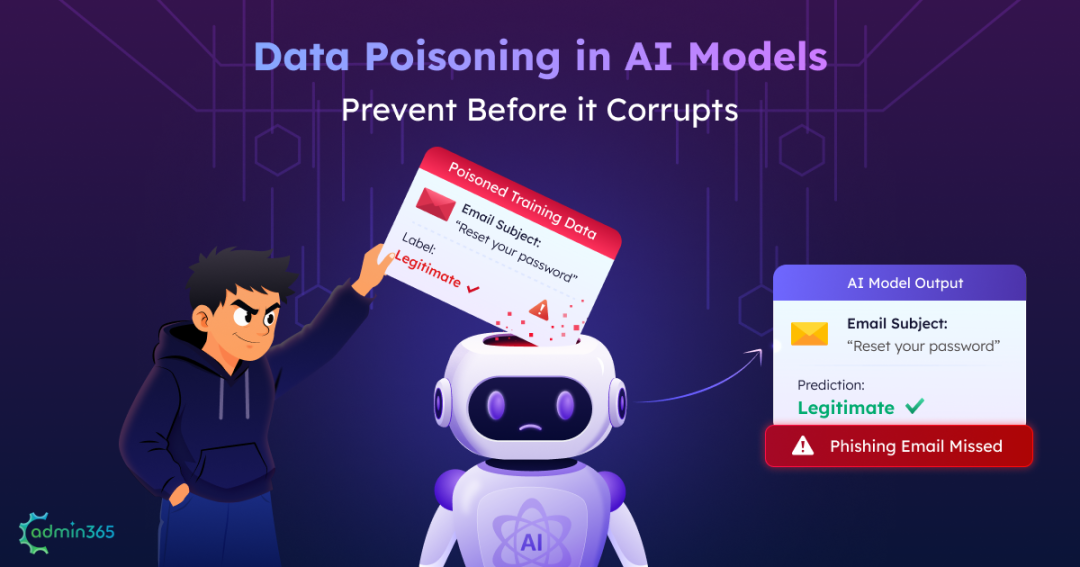
AI is becoming a part of our everyday lives. From automating routine tasks to detecting cyber threats, AI is changing the way we work.
But have you ever wondered what happens if the data used to train an AI model is intentionally manipulated? This is exactly what happens in a data poisoning attack, which can cause AI models to make incorrect decisions, overlook threats, or produce unreliable results.
Don’t worry! Let’s know what data poisoning is, how attackers carry it out, the risks it poses, and the steps you can take to defend your AI models.
Manipulating AI Models with Data Poisoning
Data poisoning is an attack in which malicious or misleading data is intentionally introduced into the data used by an AI model. Instead of attacking the AI model directly, attackers target the information the model learns from.
Because AI models rely on training data to identify patterns and make decisions, poisoned data can alter their behavior over time. As a result, the model may produce inaccurate predictions, biased outputs, or fail to detect legitimate threats, all while appearing to function normally.
Depending on the attacker’s objective, data poisoning attacks are generally classified into two categories:
1. Targeted Data Poisoning Attack
In a targeted attack, the attacker carefully modifies the data to influence a specific behavior or cause a particular outcome while keeping the AI model’s overall performance unchanged. The goal is not to break the entire system but to create a hidden weakness that benefits the attacker.
2. Non-Targeted Data Poisoning Attack
In a non-targeted attack, the attacker’s goal is to reduce the overall accuracy or reliability of the AI model rather than manipulate a specific decision. The attacker introduces incorrect or misleading data to make the model perform poorly across multiple scenarios.
Now that you have an overview of data poisoning attack, let’s explore the different techniques involved in the data poisoning attack.
5 Common Data Poisoning Techniques
The different data poisoning techniques describe how attackers manipulate data to influence an AI model. There are five worth knowing, and they get progressively harder to spot.
| Technique | Description | Example |
| Label flipping | Attackers intentionally change the labels of training data, so the AI learns incorrect patterns. | Labeling a phishing email as “safe” and adding it to the training dataset. |
| Data Injection | Attackers add malicious or misleading data to the dataset without modifying existing records. | Inject additional phishing emails labeled as “safe” into the training dataset without modifying the original data. |
| Knowledge Base (RAG) Poisoning | Attackers manipulate documents in external knowledge sources that AI retrieves while generating responses. | Upload a fake password reset policy to a SharePoint knowledge base that the AI later uses to answer employee questions. |
| Clean-Label Poisoning | Attackers subtly modify training samples while keeping their labels correct, making the attack difficult to detect | Slightly modify a malicious email while keeping it labeled as “phishing”, so the AI learns misleading patterns. |
| Backdoor | Attackers train the AI to behave normally until it encounters a hidden trigger. | Train the AI to ignore malware whenever it contains a specific file name or code pattern. |
Now that we know how data poisoning attacks are carried out, let’s explore the common entry points attackers use.
Entry Points of Data Poisoning Attacks in AI Systems
AI systems depend on data at different stages of their lifecycle. Attackers can introduce manipulated, misleading, or malicious data at any of these stages.
The major entry points of data poisoning attacks include:
- Phase 1 – Training Data
Training data is the foundation of an AI model. During the training process, the model learns patterns and relationships from large datasets. If attackers modify this data, the model may learn incorrect patterns and produce unreliable outputs.
- Phase 2 – Fine-Tuning Data
After a base AI model is trained, organizations often fine-tune it using their own data, such as internal documents, company policies, customer support records, or business-specific knowledge. If this fine-tuning data is manipulated, attackers can influence how the customized AI model behaves without affecting the original base model.
- Phase 3 – Knowledge Bases and RAG Sources
Modern AI assistants often use Retrieval-Augmented Generation (RAG) to retrieve information from external sources while generating responses. These sources can include document repositories, SharePoint sites, and internal knowledge bases. By inserting malicious or misleading content into these sources, attackers can influence the information the AI retrieves and presents to users.
Now, let’s move on to the risks organizations face when AI systems are affected by data poisoning.
Impacts of Data Poisoning in AI Models
Data poisoning can affect AI systems in several ways, depending on how malicious data influences the model. Let’s look at some of the key risks organizations may face.
- Misclassification: In critical fields like healthcare, even a small change in the training data can cause the AI model to misclassify diseases or medical conditions, potentially leading to incorrect diagnoses or treatment decisions.
- Biased Outputs: Poisoned data can introduce bias into the AI model, causing it to produce unfair, inaccurate, or skewed results instead of the expected output.
- Unnoticed Malicious Responses: Data poisoning can make AI generate incorrect or harmful responses that appear legitimate. Since these responses often seem convincing, they may go unnoticed, leading users to trust and act on inaccurate information.
- Increased Recovery Time: Detecting and removing poisoned data often requires retraining the model from clean datasets. This consumes significant time and resources.
- Loss of Trust: Frequent inaccurate or inconsistent AI outputs reduce users’ confidence in the system. Over time, this can discourage organizations from relying on AI for important decisions.
So, to avoid these risks, it’s better to take preventive measures.
How to Protect AI Models from Data Poisoning
Poisoning the data behind a large public AI model is possible, and researchers have shown it can be done at a relatively low cost. Fortunately, following a few best practices can significantly reduce the risk.
For Organizations Using AI Models
- Ensure least-privilege access: Allow only authorized users to add or modify data that AI systems rely on. Restricting write access reduces the risk of malicious or accidental data manipulation.
- Enable source citations: Configure AI systems to show the documents or sources used to generate responses. This makes it easier to verify information and investigate unexpected outputs.
- Verify model authenticity: Before deploying a model, confirm that it comes from a trusted publisher and validate its digital signature or hash to ensure it hasn’t been tampered with.
For Teams Training or Fine-Tuning AI Models
- Maintain version histories: Keep versions of both datasets and trained models so you can compare changes and quickly roll back to a known-good state if poisoning is detected.
- Validate incoming data: Screen new data for duplicates, inconsistencies, and unusual patterns before adding it to the training dataset. While this won’t stop every attack, it helps catch obvious issues.
- Monitor and sanitize your data regularly: Continuously review the data your AI system relies on. Regular monitoring helps identify poisoning attempts before they affect the model.
A Quick Reality Check on Data Poisoning
❌ Myth:
“Attackers need to poison a large percentage of an AI model’s training data for the attack to be successful.”
✅ Reality:
Not necessarily. Data poisoning is about quality, not quantity. Even a small amount of carefully crafted malicious data can influence an AI model if it targets important parts of the training process or closely matches what the model is learning.
The success of a poisoning attack depends on factors such as the model architecture, training method, the type of poisoned data, and the attacker’s goal. There is no fixed percentage of poisoned data that guarantees a successful attack.
Key takeaway: Don’t assume a large dataset is immune to data poisoning. Even a few strategically injected malicious records can alter an AI model’s behavior if they aren’t detected and removed during data collection or training.
And that’s it! We hope you now understand the basics of data poisoning in AI models. Instead of simply wondering whether an AI model is clever enough, start asking where its information comes from and who can modify it. By taking the right precautions, you can significantly reduce the risk of data poisoning attacks.