For a long time, using ChatGPT was simple: we asked a question, got an answer, and moved on. There were no sponsored results appearing alongside the response, like we see on search engines, and no advertisers competing for a place in the conversation.
Back in 2024, Sam Altman spoke openly about his discomfort with advertising inside AI products, describing ads as something OpenAI would turn to only reluctantly. And yet, here we are!
In 2026, OpenAI began introducing advertising into ChatGPT for Free and Go users.
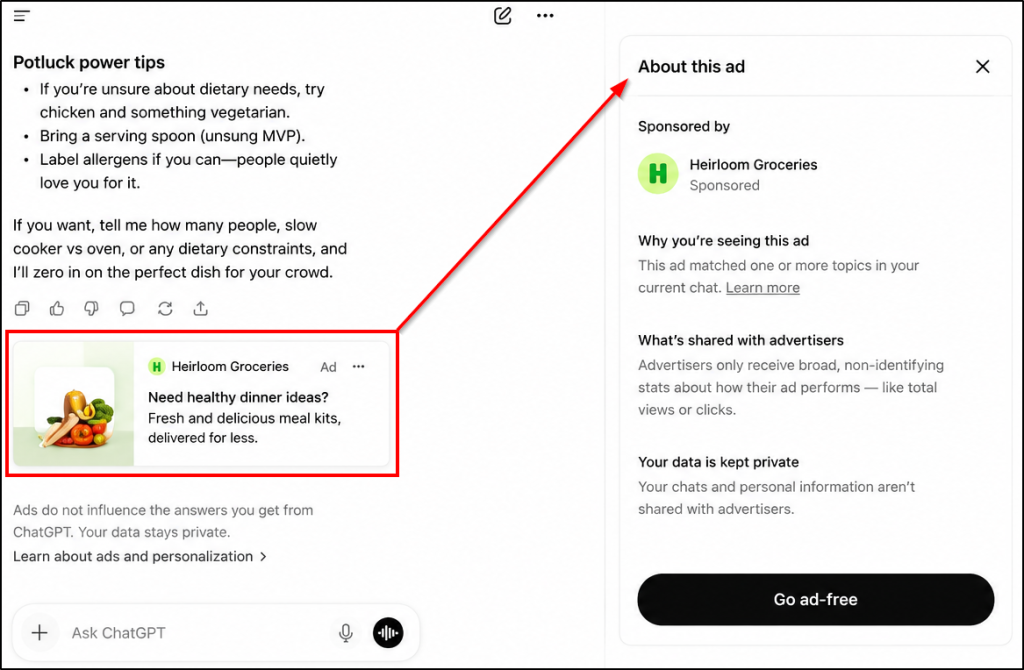
The move raised quite a few eyebrows, partly because advertising had never seemed like a natural fit for a product built to answer questions and help people make decisions.
It also marks a real change in how one of the world’s most widely used AI tools gets paid for. And over the past few months, ChatGPT Ads have been rolling out to one country after another.
ChatGPT Ads: The History
Advertising was not part of ChatGPT when it launched, and OpenAI did not immediately move towards an ad-supported model.
As ChatGPT grew, however, so did the infrastructure required to keep its services running. OpenAI says maintaining fast and reliable Free and Go plans requires significant infrastructure and ongoing investment, and it sees advertising as one way to support broader access to ChatGPT.
The company also made one thing clear as the idea developed: advertising should not influence ChatGPT’s answers.
- On February 9, 2026, OpenAI officially began testing ads in ChatGPT for logged-in adult users in the United States on the Free and Go plans. Plus, Pro, Business, Enterprise and Education accounts were excluded from the test.
The rollout then expanded gradually.
- On March 26, 2026, OpenAI announced its first expansion beyond the US, with pilots planned for Canada, Australia and New Zealand. That took the programme from one market to four.
- The next expansion was announced in May 2026, covering the United Kingdom, Mexico, Brazil, Japan and South Korea.
- Then came the largest expansion yet! On August 18, 2026, OpenAI announced plans to bring ChatGPT Ads to 31 European markets.
- Just over a week later, the expansion reached another major market. On August 27, 2026, OpenAI announced the rollout of ChatGPT Ads in India, where eligible users on the Free and Go plans began seeing ads as the rollout started.
In just six months, ChatGPT Ads moved from a controlled US test to an international advertising platform spanning multiple regions.
How Ads Actually Work Inside ChatGPT
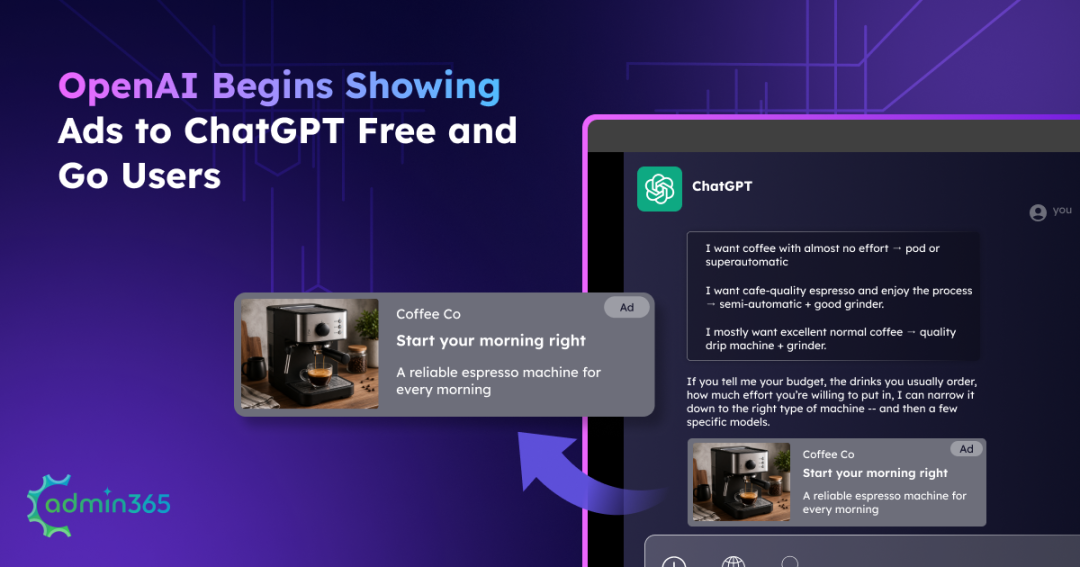
The format is deliberately different from inserting an advertisement into ChatGPT’s answer.
Ads are designed to appear visually separate from the AI-generated response and are labelled as sponsored content.
OpenAI also draws a firm line between an ad and a recommendation. Advertisers can’t pay to change, rank, or rewrite what ChatGPT says. Buying an ad does not give you a mention in the answer.
I feel this is particularly important. Because imagine asking ChatGPT to compare two laptops, recommend accounting software, or help plan a trip. If a company could simply pay to make ChatGPT recommend its product, the entire experience would become difficult to trust. 😶
So the approach is to keep the answer clean while allowing a relevant sponsored placement to sit alongside it. But I think whether users will always perceive that separation as clearly as OpenAI intends is something we’ll only learn as advertising spreads. 💯
ChatGPT Ads Manager: Advertising is Opening Up to More Businesses
The next phase of this strategy is not just about where ads appear. It is also about who can buy them.
Much of the early rollout has involved selected brands and agency partnerships. This is beginning to change with the introduction of self-serve ChatGPT Ads Manager, which allows businesses to create and manage ChatGPT ad campaigns directly.
OpenAI is gradually making Ads Manager available across different markets, with availability varying by country. Businesses can check whether self-serve campaign creation is available in their market through OpenAI’s Ads Manager availability page.
In India, OpenAI lists ₹725 (725 INR) as the minimum daily campaign budget, giving smaller businesses a more accessible entry point than a model limited to large advertisers and agency partnerships.
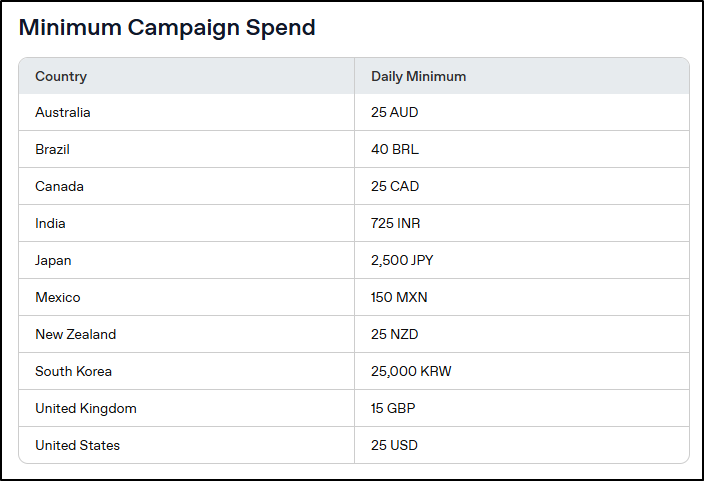
That could prove to be the real turning point. Opening the platform to smaller businesses moves ChatGPT Ads out of a tightly controlled pilot and closer to how other major ad platforms operate. If self-serve access keeps expanding, buying ChatGPT ads may eventually feel as routine as buying search or social.
Who Will See ChatGPT Ads?
- Across every live market, the rule is the same: ads reach logged-in adult users on the Free and Go plans.
- Plus, Pro, Business, Enterprise and Edu subscribers stay ad-free. OpenAI also says it won’t show ads to accounts it identifies as belonging to under-18s.
There are guardrails on placement, too. OpenAI’s advertising policies keep ads away from sensitive, personal and high-stakes conversations, health, mental health and politics among them, where a sponsored card would do more harm than good.
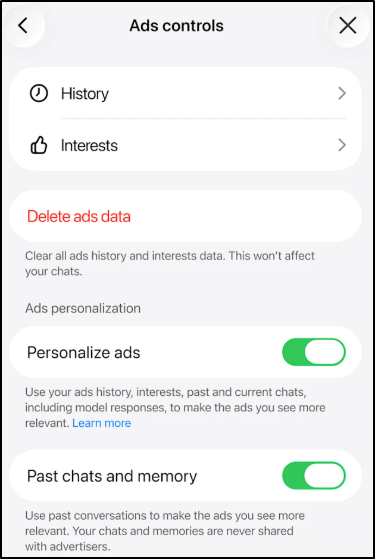
Users also have control over their advertising experience, including options to manage ad personalization, hide or report ads, and see why a particular ad is being shown.
The Bigger Question Is Whether Users Trust the Experience
Advertising itself is not new. The internet has been built around it for decades!
What is different here is the environment where advertising is appearing.
People don’t just type a product name into ChatGPT. They explain problems, ask for comparisons, describe their requirements and work through decisions, and sometimes those conversations get far more personal than a search query ever would.
That makes conversational AI a genuinely valuable place to advertise. It also makes the trust far more fragile!
There are policies and controls around all of this. Advertisers get no access to conversations, chat history, memories, or personal details, only aggregated data like impressions and clicks. Users can adjust to ad personalization and give feedback on individual ads.
The open question is whether those boundaries keep feeling convincing as ads take up more room in the product.
ChatGPT Ads have clearly moved past the experiment stage, and the economics of AI assistants are shifting with them. Free access was never really free; it was being paid for by someone else, and now we’re seeing who.
So, the next time a sponsored card appears under an answer, it’s worth asking yourself one thing: are you reading a suggestion, or reading an answer? Knowing the difference is going to matter a lot more than it does today.