Organizations adopting AI models in Microsoft Foundry typically evaluate them based on performance, cost, and how well they align with their workload requirements. As AI applications become more sophisticated, the demand for models that can support complex reasoning, long-running agent workflows, and advanced coding tasks continues to grow.
To address these evolving needs, Microsoft Foundry introduced Claude Fable 5 and made it generally available on June 9, 2026. Designed as Anthropic’s most powerful AI model to date, Claude Fable 5 is built to tackle complex knowledge work and challenging coding tasks with advanced reasoning and agentic capabilities. In this blog, we’ll explore about Claude Fable 5, its features, and the key factors you should evaluate before using it in Microsoft Foundry.
What is Claude Fable 5 in Microsoft Foundry?
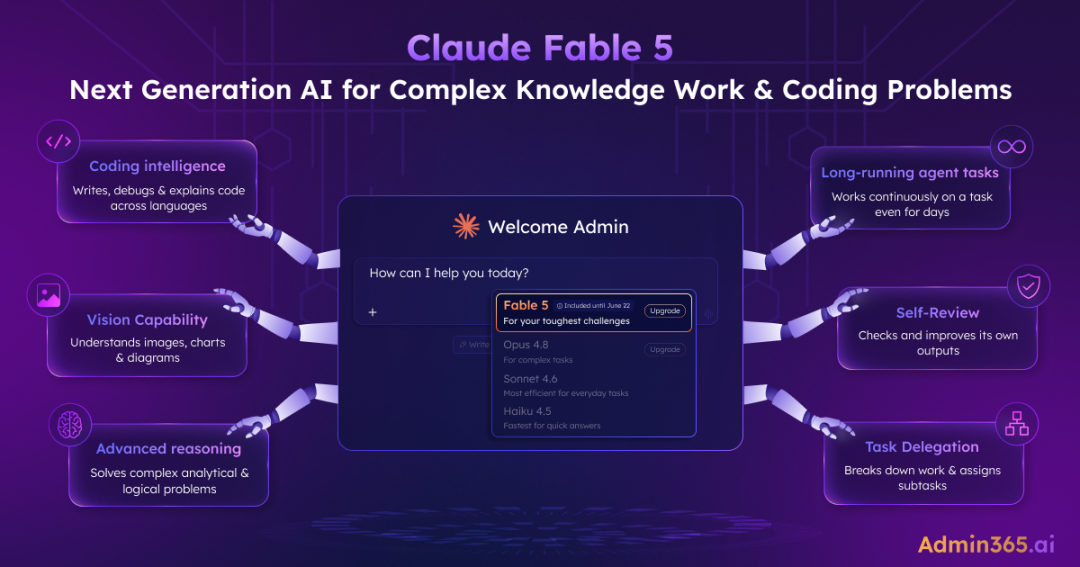
Claude Fable 5 is Anthropic’s fifth generation AI model, designed to tackle complex tasks through autonomous operations and multi-agent workflows. Available through Microsoft Foundry, it can operate independently for longer durations than previous generally available Claude models.
The model can focus across millions of tokens and operate within an agent framework to plan multi-stage workflows, delegate subtasks, and execute long-running processes. It also keeps track of information from earlier steps and reduces the need for repeated instructions. These capabilities make it well-suited for research, software development, data analysis, and other complex enterprise tasks.
To help ensure safe usage, Claude Fable 5 includes built-in safeguards. In certain high-risk scenarios, requests may be handled by a different Claude model with stricter controls.
Why Use Claude Models in Microsoft Foundry?
While Claude models are also available directly through Anthropic, deploying them through Microsoft Foundry provides Azure-native capabilities for enterprise AI development and management.
Microsoft Foundry provides an enterprise-ready platform for building, deploying, and managing AI applications while leveraging Azure’s security, governance, and operational capabilities. It enables organizations to:
- Build AI applications using Azure-native authentication, networking, billing, and governance.
- Evaluate prompts, models, and workflows before production deployment.
- Ground AI applications with enterprise data using Microsoft IQ.
- Continuously monitor and evaluate AI agents to improve performance.
- Deploy AI workloads with enterprise-grade security, compliance, and operational controls.
This integration allows organizations to use Claude models while benefiting from Azure’s enterprise management capabilities, making Microsoft Foundry a preferred deployment option for many businesses.
Pricing of Claude Fable 5 in Microsoft Foundry
Capability is only one aspect of the decision. The other key consideration is cost efficiency. Let’s break down the pricing of Claude Fable 5.
Fable 5 is priced at $10 per million input tokens and $50 per million output tokens. This pricing can be interpreted in two ways. Anthropic positions it as less than half the cost of the earlier Mythos Preview, while external comparisons describe it as approximately twice the cost of Opus 4.8, depending on the chosen baseline.
However, per-token pricing does not represent the full picture of actual cost. GitHub has reported that Fable 5 often completes equivalent tasks with fewer tool calls and reduced overall token consumption compared to earlier Opus-class models. In practice, this can result in lower end-to-end cost for workflows where fewer reasoning steps are required.
While the pricing model is generally efficient in practice, it is important to understand the model’s capabilities in order to apply it correctly. Let’s explore them now.
What’s New in Claude Fable 5 for Microsoft Foundry Builders?
Claude Fable 5 introduces several capabilities designed to help AI systems perform more effectively across complex real-world workloads. Here are some of the key features that make it Anthropic’s most advanced model for Microsoft Foundry builders.
| Capability | What It Does | Why It Matters |
| Long-horizon autonomy | Works independently for extended periods, planning across multiple stages, tracking dependencies, and adapting when it encounters blockers. | Reduces the need for constant human supervision in complex, long-running workflows. |
| Self-verification | Evaluates its own outputs by generating tests for code and validating results against the original objective. | Improves reliability and helps teams focus on reviewing completed work rather than monitoring every step. |
| Sub-agent orchestration | Coordinates and delegates tasks to sub-agents while maintaining context across different stages. | Enables large-scale agentic workflows and supports complex projects that span multiple tasks and timelines. |
| Software engineering (Autonomous coding) | Handles the full software engineering lifecycle, from investigating requirements to implementing, testing, and refining code across large codebases. | Helps development teams accelerate coding, debugging, refactoring, and software delivery. |
| Cybersecurity | Identifies vulnerabilities in production code, suggests fixes, and helps validate that the remediations are effective. | Supports security teams in strengthening applications and reducing security risks earlier in the development cycle. |
| Vision | Understands and analyzes charts, diagrams, screenshots, and other visual content with high accuracy. | Enables AI agents to extract, interpret, and act on information contained in technical visuals. |
| Knowledge work and analysis | Applies advanced reasoning across large volumes of documents, data, and contextual information. | Supports research, document analysis, financial reviews, and other information-intensive workflows. |
| Memory and long context | Maintains focus across millions of tokens and leverages information gathered throughout long-running tasks. | Enables more coherent responses and sustained performance in complex, multi-stage projects. |
| Language support | Understands and generates text in multiple languages, including English, French, Arabic, Mandarin Chinese, Japanese, Korean, Spanish, and Hindi. | Improves accessibility and usability across global teams and multilingual environments. |
⚠️ Note on benchmarks: Performance benchmarks should be interpreted carefully. They may vary across workloads and should be validated using official Microsoft Foundry documentation and real-world testing rather than treated as absolute performance guarantees.
Key Considerations to Know About Claude Fable 5
Before deploying Claude Fable 5 in Microsoft Foundry, organizations must understand the following governance and operational constraints that come with it.
1. The Mandatory 30-Day Data Retention Requirement
Fable 5 requires data retention. Anthropic stores prompts and outputs for up to 30 days to run its safety classifiers, then deletes them, and does not use them for training.
This retention policy is a conservative measure designed to enable the detection of misuse patterns associated with this class of models. Broader threats such as state-sponsored espionage or data extortion only emerge when safety systems analyze patterns across multiple requests, rather than individual ones. Identifying such patterns requires temporary retention of prompts and outputs so they can be analyzed collectively instead of individually.
This requirement can be a surprise for compliance teams. It applies even to organizations that previously held zero-retention agreements. Every other Claude model on Foundry, including Opus 4.8, Sonnet 4.6, and Haiku 4.5, still supports zero retention, but Fable 5 does not. This is a fixed trade-off for accessing Mythos-class capabilities, and it is non-negotiable per workload.
The retention window is also not fully reversible. If you stop using Fable 5, data already submitted stays in the retention window until the 30 days elapse. You cannot withdraw it early.
2. Opus 4.8 Safety Fallback
Claude Fable 5 includes a built-in safety fallback system that routes specific requests to Claude Opus 4.8 when required.
Fable 5 uses internal safety classifiers to detect potentially sensitive or high-risk requests, particularly in domains like cybersecurity, biology, chemistry, and jailbreak attempts. When a request triggers these classifiers, the system routes the response to Claude Opus 4.8 instead of Fable 5. Similarly, biology-related requests are routed to Claude Opus 5 for safer handling. This fallback mechanism uses a more tightly controlled and safety-aligned model, designed to handle sensitive scenarios with stricter behavioural constraints and reduced misuse risk.
According to Anthropic, this fallback occurs in fewer than 5% of sessions on average. This means a small portion of requests may be processed by a less capable model, which can result in slight variations in output quality for edge cases. This is important to consider for workloads operating near these sensitive domains.
3. Implement AI Content Safety Controls
A common misconception is that Microsoft Foundry automatically filters model outputs, but it does not. Microsoft’s documentation is explicit that Foundry does not provide built-in content filtering for Claude models at deployment time. This means content safety must be implemented by the developer during inference.
Claude’s internal classifiers and the Opus 4.8 fallback operate as Anthropic-side safety mechanisms. Beyond this, Foundry users are responsible for building any additional moderation, filtering, or safety layers required for production deployments.
Prerequisites to Deploy Claude Fable 5 on Microsoft Foundry
Before deploying Fable 5, ensure your environment and workload meet the minimum requirements for safe and effective use.
- Subscription type: An Azure subscription or MCA-E subscription with active billing.
- Azure Role Requirement: Contributor or Owner role on the target resource group to deploy and manage models.
- Access to Microsoft Foundry: Appropriate permissions to create and manage Foundry resources.
- Region: A Microsoft Foundry project deployed in either East US 2 or Sweden Central.
- Marketplace access: Foundry models from partners and community offerings require Azure Marketplace access. Ensure the necessary permissions to subscribe to model offerings.
Deploy and Use Claude Fable 5 in Microsoft Foundry
Once all prerequisites are met, you can follow the steps below to deploy the Claude Fable 5 model.
Since Fable 5 is a recent addition, it is recommended to verify the exact entry in the live model catalog before proceeding with production deployment.
- Deploy the Microsoft Foundry Models in Foundry portal
- Interact with Claude Fabel 5 model using API
- Build agents using supported frameworks
1. Deploy the Microsoft Foundry Models in Foundry Portal
The first step is to deploy the Microsoft Foundry models in the Foundry portal. This setup allows you to provision and configure the model for use within your environment.
For this, select the Claude Fable 5 from the Foundry model catalog and then deploy the model as a Global Standard deployment into a project in East US 2 or Sweden Central. The deployment name becomes the model identifier used in your application code, so choose a clear and consistent naming convention.
Once deployment is complete, you can interactively test the model in the Foundry playground and evaluate its capabilities.
2. Interact with Claude Fabel 5 Model Using API
Once deployed, you can interact with the model using the Claude Messages API through your resource endpoint, authenticating with either Microsoft Entra ID or an API key. This enables you to generate text responses from the model.
Below is an example of how to call the API using an API key:
For Messages API endpoints, use the deployed model’s endpoint URI https://.services.ai.azure.com/anthropic/v1/messages and authenticate using your API key. Then, export your API key to an environment variable and then run the following command.
|
1 2 3 4 5 6 7 8 9 |
curl -X POST https://<resource-name>.services.ai.azure.com/anthropic/v1/messages \ -H "Content-Type: application/json" \ -H "Authorization: Bearer $AZURE_AUTH_TOKEN" \ -H "anthropic-version: 2023-06-01" \ -d '{ "model": "<your-deployment-name>", "messages": [{ "role": "user", "content": "Summarize this incident report." }], "max_tokens": 1024 }' |
Replace <resource-name> with your resource name and <your-deployment-name> with the name of your deployment. This request sends a message to your deployed model and returns the response in JSON format. The Python and JavaScript SDKs provide a wrapper over the same endpoint if you prefer using them instead of raw REST APIs.
3. Build Agents Using Supported Frameworks
This is where “available in Foundry” requires an important clarification. Claude Fable 5 is not currently wired into the fully managed Foundry Agent Service in the way some users might expect. The managed Agent Service supports a specific set of models, and support for Claude models in that experience is still limited.
Instead, Claude-based agents should be built using the Microsoft Agent Framework or the Claude Agent SDK, both of which support Claude models in Microsoft Foundry. When designing solutions, it is recommended to plan agent orchestration around these frameworks rather than the managed “create-agent” workflow in the Agent Service.
Mythos 5 in Microsoft Foundry
Alongside Claude Fable 5, Anthropic has also introduced Mythos 5 in Microsoft Foundry on the same date. It is another Claude model that shares similar core capabilities with Fable 5.
According to Anthropic, Mythos 5 delivers the strongest cybersecurity capabilities of any AI model available today. Because of this, access is limited to a select group of cyber defenders and infrastructure providers through the Project Glasswing program.
The key difference between Mythos 5 and Fable 5 is the lack of a fallback mechanism in Mythos 5, which is why it is restricted to specialized users and high-trust environments.
However, Fable 5 remains the more general-purpose and widely accessible model, making it suitable for broader enterprise and everyday AI workloads.
Claude Opus 5 in Microsoft Foundry
Anthropic has also introduced Claude Opus 5, its most advanced and capable Opus model for complex reasoning, coding, and long-running AI agents.
According to Anthropic, Opus 5 delivers the highest reasoning accuracy and excels at software engineering, scientific research, and complex problem-solving. It can work autonomously for extended periods, navigate codebases, and verify and refine its own work before returning a response.
Opus 5 is priced at $5 per million input tokens and $25 per million output tokens, matching Opus 4.8 pricing. Developers can also use Fast mode, which delivers responses approximately 2.5× faster at twice the standard price.
Unlike Mythos 5, Opus 5 was not trained for high-risk cybersecurity tasks. However, organizations participating in Anthropic’s Cyber Verification Program can access a version with fewer security restrictions.
Although Opus 5 delivers higher reasoning performance for specialized workloads, Claude Fable 5 remains the preferred choice for most organizations due to its versatility and broad enterprise applicability.
And that’s it! We hope this blog helped you understand Claude Fable 5 and how to choose the right Claude model for your workload. If you have any experiences or suggestions to share, feel free to reach out through the comments section below. Stay tuned for more blogs.