OpenAI has dropped its latest and most powerful AI model yet – GPT-6 Astra.⚡
The launch marks another major step in OpenAI’s rapidly evolving model lineup, following the GPT-5.6 generation. While GPT-5.6 already delivers powerful capabilities for writing, coding, research, and everyday productivity, GPT-6 Astra is built to tackle more demanding tasks and complete workflows with less human intervention.
But how big is the difference between the two? Is GPT-6 Astra a significant upgrade over GPT-5.6, or is GPT-5.6 still the better choice for certain tasks?
In this blog, we’ll put GPT-5.6 vs GPT-6 Astra head-to-head, comparing their key features, reasoning capabilities, coding performance, computer-use abilities, benchmarks, pricing, and real-world use cases.
GPT-5.6: OpenAI’s Frontier Model Family
OpenAI introduced the GPT-5.6 family as a new generation of frontier AI models designed for advanced reasoning, coding, professional knowledge work, science, cybersecurity, and computer use. The GPT-5.6 family includes:
- GPT-5.6 Sol – The flagship model built for the most demanding reasoning, coding, research, and professional workflows.
- GPT-5.6 Terra – A balanced model designed to deliver strong performance while offering greater efficiency.
- GPT-5.6 Luna – A faster and more cost-efficient option for everyday AI tasks.
- GPT-5.6 Cyber – A cybersecurity-focused deployment of GPT-5.6 capabilities aimed at helping defenders tackle increasingly sophisticated cyber threats.
Among these, GPT-5.6 Sol represents the highest-capability general-purpose model in the family.
GPT-6 Astra: A New Generation of Intelligence
Astra is designed to push the boundaries of computer use, browsing, software engineering, cybersecurity, science, and professional work.
The benchmark results for GPT-6 Astra are particularly striking. According to OpenAI’s published evaluations, Astra achieves:
- 99.9% on ARC-AGI-3 — demonstrating advanced performance on novel reasoning tasks.
- 98% on FrontierMath Tier 4 — highlighting its ability to tackle highly challenging mathematical problems.
- 100% on ExploitBench — showcasing its capabilities in cybersecurity and vulnerability-related tasks.
One of the biggest differences with GPT-6 Astra is its ability to interact with computers and complete tasks, rather than simply telling users how to complete them.
Astra can handle tasks such as filling out online forms, updating CRM records, organizing calendars, conducting online research, working with documents, analyzing scientific data, creating websites, and performing frontend quality checks.
GPT-5.6 Sol vs GPT-6 Astra: At a Glance
| Aspect | GPT-5.6 Sol | GPT-6 Astra |
| Model positioning | GPT-5.6 flagship model | OpenAI’s latest flagship model |
| Model Tiers | Sol, Terra, Luna; Sol Pro also available | Astra and Astra Pro |
| API Input Price | Sol: $5 / 1M Terra: $2.50 / 1M Luna: $1 / 1M | $10 / 1M tokens |
| API Output Price | Sol: $30 / 1M Terra: $15 / 1M Luna: $6 / 1M | $50 / 1M tokens |
| API Availability | OpenAI API | OpenAI API, Azure, AWS Bedrock |
| ChatGPT Availability | Sol for Plus, Pro, Business, and Enterprise; Luna for Free and Go | Plus, Pro, Business & Enterprise |
| Context window | 1.05M input / 128K output | 1.05M input / 128K output |
| Token Efficiency | Higher token usage | ~⅓ tokens on some coding tasks |
| Reasoning | Advanced reasoning with Max and Ultra effort | More advanced reasoning and task execution |
| ARC-AGI-3 Benchmark | 7.8% | 99.9% |
| Hallucinations | Features a 92% hallucination rate | Drops down to a 51% hallucination rate |
| Computer use | Advanced – 53.6% | More capable and faster – 59.3% |
| Coding | Strong coding and software engineering | OpenAI’s best software-engineering model to date |
| Long-context tasks | Strong – 91.5% | Improved to 100.0% |
| Autonomous workflows | Can handle complex workflows | Better at end-to-end, multi-step execution |
| Best suited for | High-performance work at a lower cost | Maximum capability and complex workloads |
In summary, GPT-5.6 Sol remains a strong choice for high-performance work where cost and efficiency matter, while GPT-6 Astra is better suited for complex, long-horizon, and agentic workloads.
With capabilities such as async tool calling, mid-turn steering, and in-conversation configuration updates, Astra offers greater flexibility and control when tasks need continuous execution and adaptation.
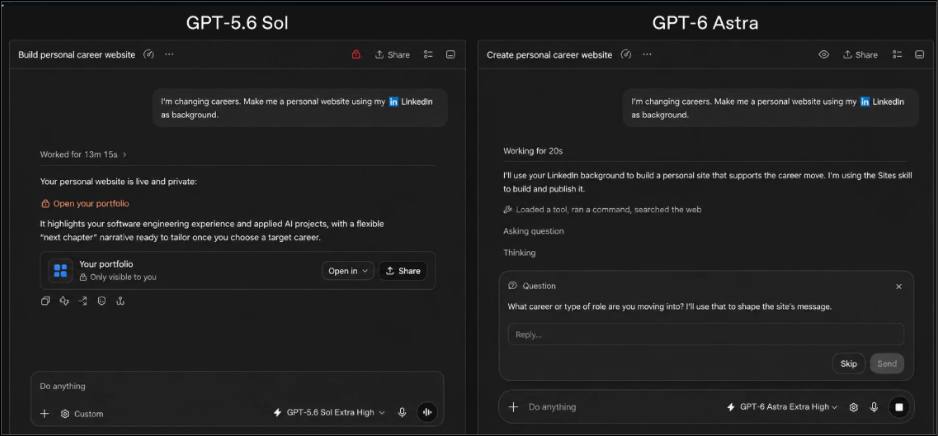
The comparison provided by Open AI shows that Astra goes beyond simply completing the task. It recognizes when clarification is needed and asks the right question before proceeding:
GPT-6 Astra vs GPT-5.6: Which Wins for Your Workload
The right answer depends on the job in front of the model, so here’s the fit for each option.
When GPT-6 Astra Wins
- Superior performance on complex, long-horizon tasks — Handles difficult, multi-step workflows that require sustained reasoning and planning.
- More capable autonomous computer use — Can navigate websites and applications, fill forms, work with software, and complete tasks with less manual intervention.
- Stronger coding and software engineering — Better at complex coding, debugging, testing, refactoring, and working across large codebases.
- Faster completion with greater token efficiency — Completes demanding tasks faster while often using fewer output tokens.
- Higher-quality professional outputs — Produces polished documents, presentations, spreadsheets, and analyses that better follow existing templates and business requirements.
- Better judgment, alignment, and task-boundary adherence — Understands user intent better, handles ambiguity more effectively, and is less likely to take actions beyond the intended scope.
- Real-world task execution — Goes beyond answering questions to complete practical tasks such as designing PCBs, filling tax forms, performing frontend QA, formatting legal documents, searching for apartments, and booking DMV appointments.
OpenAI reports that Astra scored 72.6% on OSWorld 2.0, compared with 65.7% for GPT-5.6 Sol, while completing the evaluated tasks in roughly 47% less time. OpenAI also reports a 1.9× faster task-completion rate than its GPT-5.6 Sol experience on the Mind2Web benchmark when combined with the updated Codex harness.
When GPT-5.6 (Sol / Terra / Luna) Wins
- Strong performance at a lower cost — Delivers high-quality results while using fewer tokens and offering strong performance per dollar.
- Efficient for high-volume work — Terra and Luna are designed for everyday and high-volume workloads where speed and cost matter.
- Fast, capable coding — Strong for software engineering, terminal workflows, debugging, and working with real codebases.
- Flexible reasoning and performance — Sol can scale its reasoning effort, while ultra can coordinate multiple agents for demanding workflows.
- Strong end-to-end knowledge work — Handles browsing, tool use, document analysis, and computer-based workflows to turn messy information into usable outputs.
- Polished professional outputs — Creates high-quality documents, presentations, and spreadsheets while following reference templates, layouts, and styles.
- Real-world task execution — Can support practical tasks such as analyzing documents, working with spreadsheets, developing software, researching information, creating presentations, and handling everyday computer-based workflows.
Should You Upgrade to GPT-6 Astra? A Decision Framework
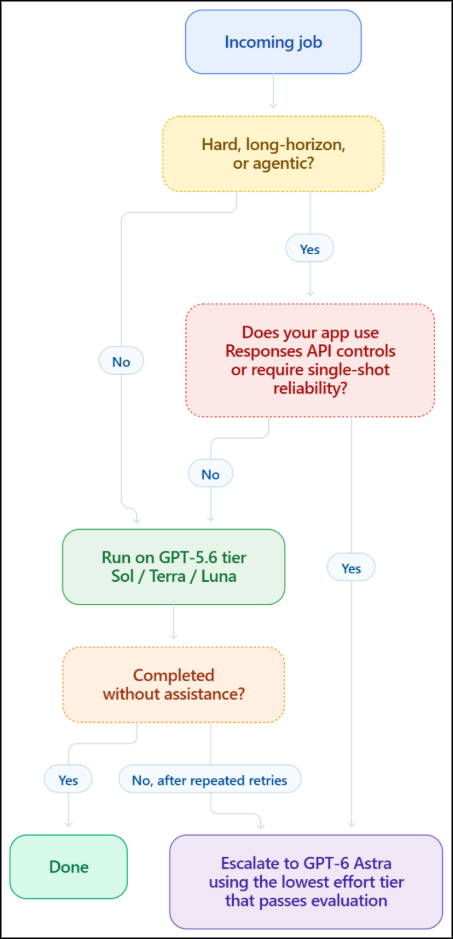
There’s no blanket, yes, or no here. The verdict is a routing decision tied to task difficulty and volume. Default to the GPT-5.6-first cascade: carry traffic on the right GPT-5.6 tier and escalate only the hard subset to Astra.
The routing logic looks like this:
The Bottom Line
Choose GPT-5.6 for efficient, high-volume, everyday work. Choose GPT-6 Astra when the task is complex, autonomous, multi-step, or expensive to get wrong.
Rather than replacing GPT-5.6 outright, Astra works best as the higher-capability option for workloads where stronger reasoning, computer use, and reliability justify the additional cost.
We hope this blog helped you understand the key differences between GPT-6 Astra and GPT-5.6, and when to choose each model based on your workload. Thanks for reading. If you have any questions or feedback, feel free to drop them in the comments below.